Quick answer:
Baby girl nursery wall decor can feel charming without relying on pink walls or elaborate decorations. Botanical prints, removable wallpaper, painted arches, personalized name art, and woodland illustrations add personality without overwhelming the room. The key is choosing one focal feature and keeping surrounding details simple. Secure wall decor properly, and keep shelves, hanging items, and cords away from the crib and out of your baby’s reach.
A nursery wall can look beautiful with just one thoughtful detail or feel cluttered despite being filled with expensive decorations. The difference often comes down to something easily overlooked: scale, placement, and how each piece works with the rest of the room.
That gorgeous floral wallpaper might overwhelm a small nursery, while a tiny framed print can disappear on a large, empty wall. And not every Pinterest-worthy arrangement belongs near a baby’s crib, where safety matters more than appearance.
The good news? You don’t need a big budget or a complete makeover to get it right. These 15 baby girl nursery wall decor ideas explore creative ways to add personality, balance colors and patterns, and make even simple walls feel special without sacrificing practicality or safe placement.
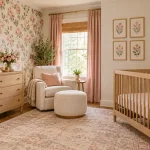
1. Create a Soft Floral Wallpaper Accent Wall
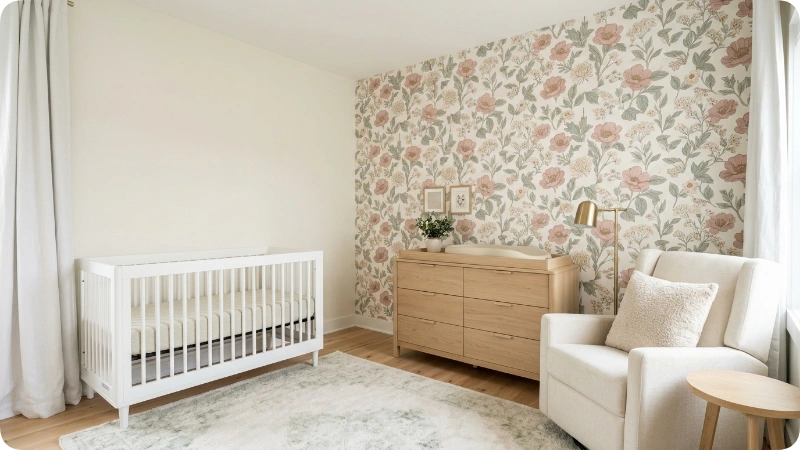
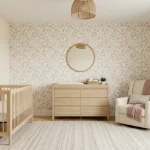
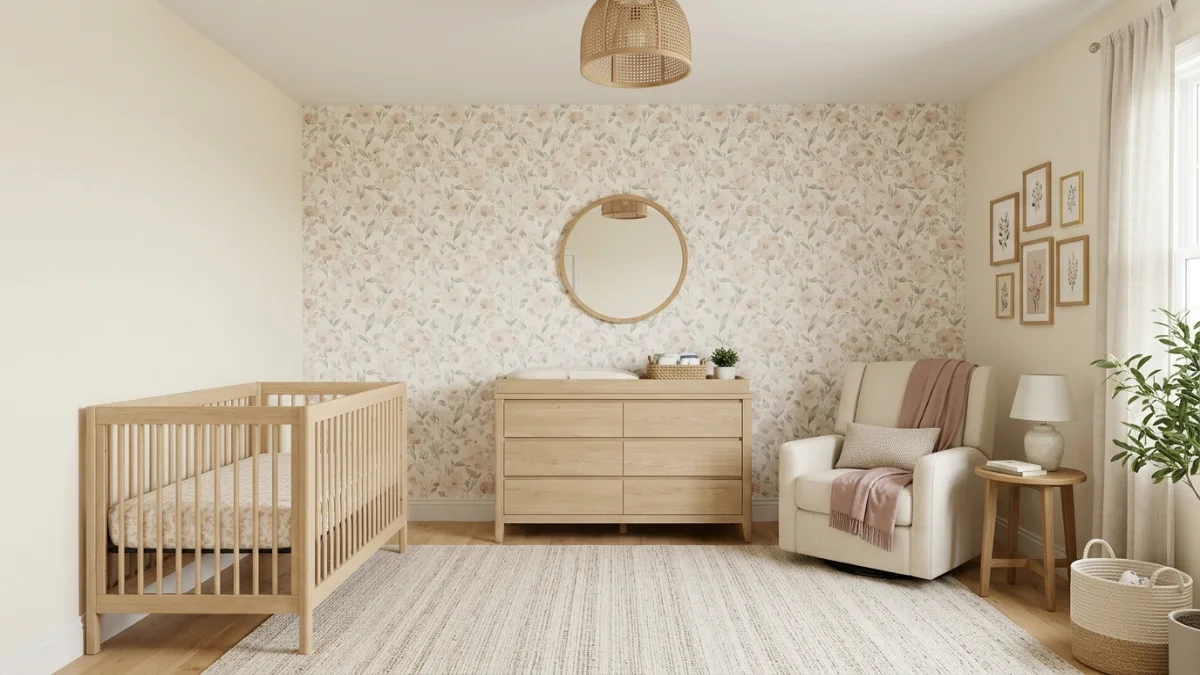
Floral wallpaper can give a nursery a distinctive look without requiring much additional decoration.
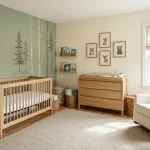
Small botanical prints create a delicate, traditional atmosphere. Larger flowers make a stronger statement and work particularly well when the rest of the room is simple.
For a baby girl’s nursery, consider muted rose, sage green, ivory, pale peach, or soft lavender.
How to make it work:
- Choose one wall as the decorative focal point.
- Keep the remaining walls neutral.
- Repeat one wallpaper color in the rug or curtains.
- Pair detailed patterns with simple furniture.
- Use wallpaper suited to the wall surface and follow the manufacturer’s installation instructions.
For a small room, wallpaper with a light background can keep the design from feeling visually heavy.
Best placement: A wall behind an anchored dresser or adult seating area, away from the crib.
Design tip: Before ordering wallpaper, tape a large sample to the wall and view it in morning and evening light. A pattern that looks subtle online may appear much busier across an entire wall.
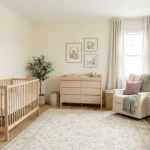
2. Arrange a Botanical Print Gallery Wall
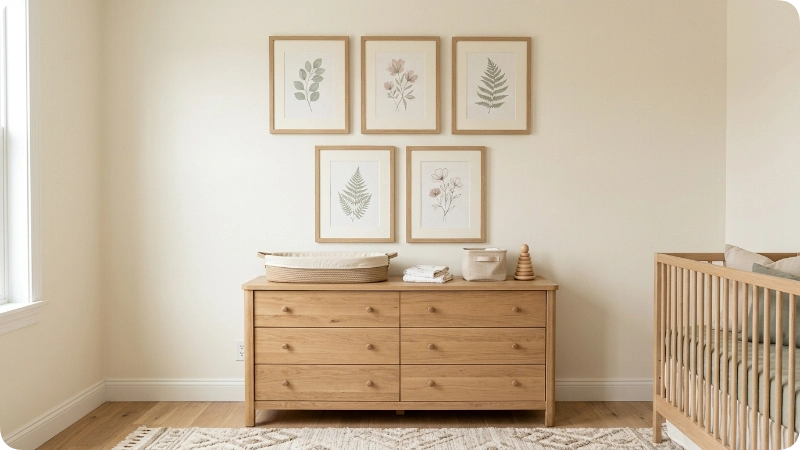
A botanical gallery wall introduces gentle color and natural shapes without requiring permanent wall treatments.
You can combine illustrations of leaves, flowers, branches, and wildflowers in matching frames.
The arrangement works particularly well in neutral, vintage-inspired, cottage-style, and woodland nurseries.
How to create the look:
- Choose three to five coordinating prints.
- Use similar frame finishes for consistency.
- Arrange the artwork on the floor before hanging it.
- Keep spacing reasonably consistent.
- Center the overall arrangement above a suitable dresser or another area away from the crib.
For a clean appearance, choose illustrations with similar background colors. Cream-colored prints in light wood frames, for example, can look coordinated even when each illustration is different.
Best placement: A clear wall above securely anchored storage furniture, provided the artwork is installed safely and is not reachable.
Budget-friendly alternative: Use a single larger botanical print instead of several smaller frames.
3. Add Personalized Baby Name Wall Art
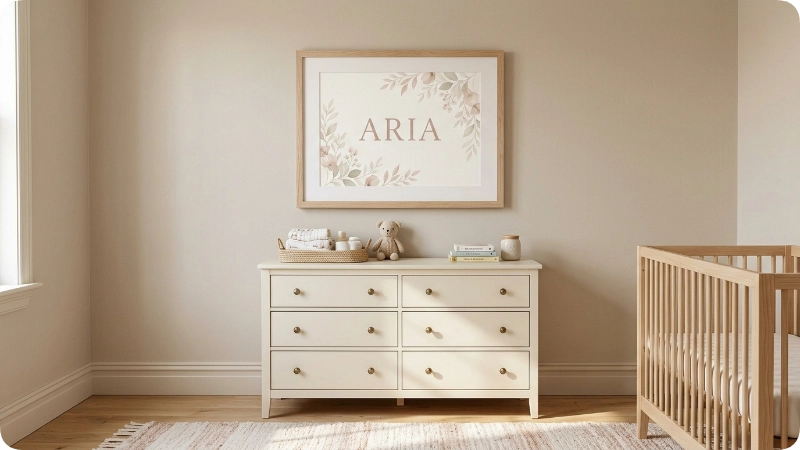
Personalized name art makes the nursery feel individual without committing to a particular theme.
A baby’s name can appear in a framed print, a painted mural, or securely installed dimensional lettering.
The design can be playful or understated depending on the typography.
For a traditional nursery, consider a simple serif font with soft floral details. For a modern nursery, clean lettering in a neutral color often works better.
How to style it:
- Choose a lettering style that matches the furniture and overall room.
- Keep the name readable rather than overly decorative.
- Use one or two colors from the existing palette.
- Avoid surrounding the name with too many competing elements.
- Install all components securely and away from the crib.
Best placement: Above a dresser, near an adult reading chair, or on an entry wall.
Safety consideration: Dimensional wooden or acrylic letters may detach if their adhesive or mounting fails. Use suitable hardware and keep them away from sleeping and reachable areas.
Design tip: A framed personalized print is generally easier to move or replace than individual wall-mounted letters.
4. Paint a Gentle Rainbow Mural
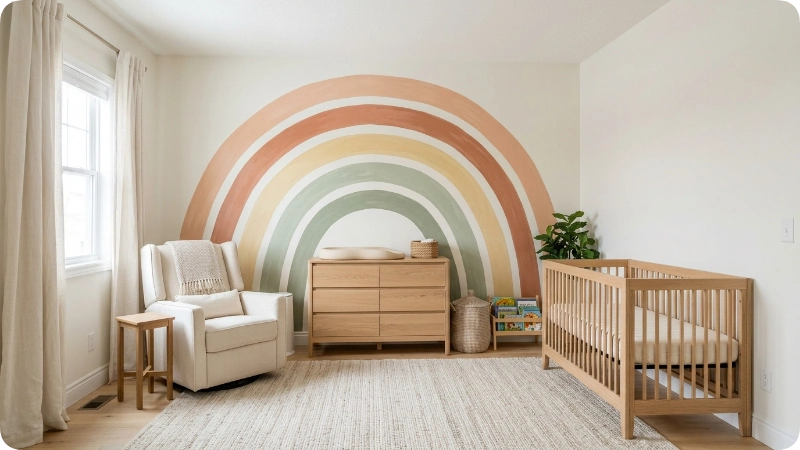
A rainbow mural brings color to the nursery while keeping the design simple.
Instead of bright primary colors, consider muted peach, terracotta, dusty pink, sage, and pale yellow.
These shades work well with natural wood furniture and warm white walls.
How to create the look:
- Choose a wall away from the crib.
- Sketch the rainbow shape lightly.
- Use painter’s tape where appropriate to establish clean boundaries.
- Paint each band using suitable interior paint.
- Follow the paint manufacturer’s drying, curing, and ventilation instructions.
A wide, low rainbow can work above an anchored dresser, while a taller design may suit an empty corner.
Best placement: A feature wall near storage furniture or an adult seating area.
Design tip: Leave some blank wall around the rainbow. The empty space helps the colors stand out and keeps the design from competing with furniture.
5. Use Butterfly Wall Art for a Delicate Look
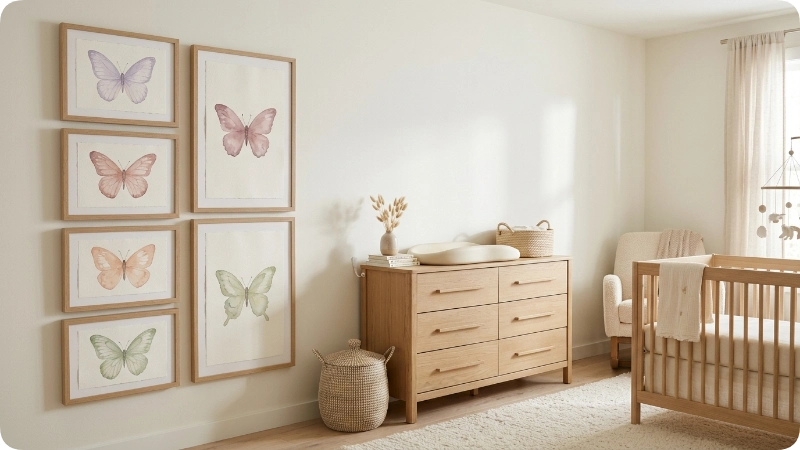
Butterfly artwork can make a nursery feel light and playful.
Watercolor butterflies create a softer appearance, while simple line drawings work well in minimalist rooms.
You can arrange butterfly illustrations in a vertical group, a small gallery wall, or one oversized framed print.
For a coordinated palette, try lavender, blush, ivory, and muted peach.
How to make it work:
- Choose a consistent illustration style.
- Keep the frames similar in color.
- Limit the arrangement to one wall.
- Balance detailed artwork with plain surrounding surfaces.
- Mount artwork securely away from the crib.
Avoid placing loose paper butterflies, removable dimensional decorations, or adhesive ornaments above the sleep area.
Best placement: A dresser wall or a decorative corner away from the baby’s sleeping space.
Design tip: One oversized butterfly illustration can be more effective than many small decals, especially in a compact nursery.
6. Add a Painted Arch Behind a Dresser
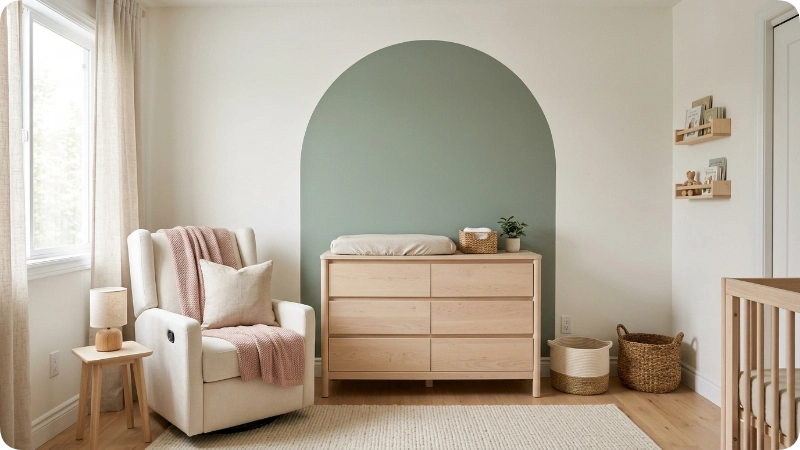
A painted arch introduces architectural interest without installing panels or wallpaper.
It creates a visual frame around a piece of furniture and can help define a nursery area within a larger room.
Muted sage, dusty rose, warm beige, and soft terracotta are useful colors for this approach.
How to create the look:
- Select a dresser or storage unit as the focal point.
- Measure the furniture width.
- Make the painted arch slightly wider than the furniture for visual balance.
- Use a curved template or a pencil-and-string method to mark the shape.
- Paint carefully and allow the finish to cure as instructed.
The arch should feel connected to the furniture rather than floating awkwardly above it.
Best placement: Behind a securely anchored dresser on a wall away from the crib.
Design tip: Keep the rest of the wall plain. The arch already provides enough visual structure without additional artwork.
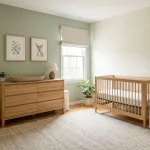
7. Decorate With Woodland Animal Illustrations
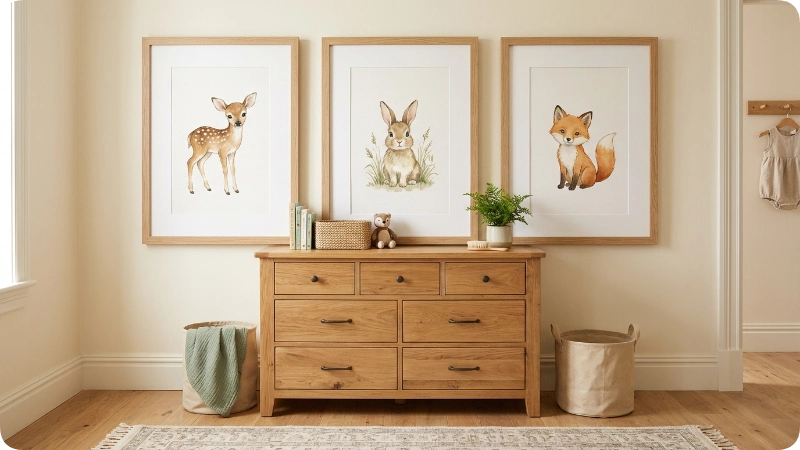
Woodland illustrations introduce recognizable characters without requiring a full animal-themed nursery.
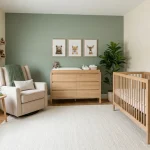
Softly illustrated rabbits, deer, foxes, and birds work well with sage green, cream, and natural wood.
For a more refined look, choose artwork that uses similar drawing techniques and colors.
How to style it:
- Select two or three animal illustrations.
- Use matching frames.
- Combine the prints with neutral walls.
- Introduce woodland colors through the room’s existing furnishings.
- Avoid placing framed artwork directly above the crib.
A trio of animal prints can look especially balanced on a wall above a low dresser.
Best placement: A dresser wall or adult reading corner.
Design tip: Choose either realistic watercolor animals or simple cartoon-style illustrations. Mixing several artistic styles can make the display feel disconnected.
8. Create a Moon and Stars Accent Wall
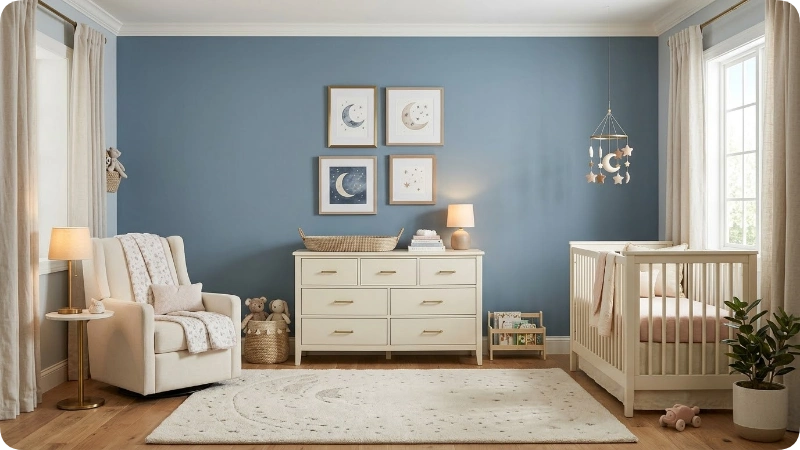
Moon and star artwork offers a dreamy nursery look without relying on traditional pink decor.
A celestial wall can be created using paint, wallpaper, or framed illustrations.
For a soft effect, combine warm white, pale lavender, dusty blue, and muted gold.
For a more dramatic look, use a deep blue accent wall with restrained celestial details.
How to make it work:
- Choose one primary background color.
- Use moons and stars in a consistent scale.
- Keep metallic details subtle.
- Balance darker colors with light furniture.
- Avoid hanging star garlands or decorations near the crib.
Best placement: An accent wall away from the baby’s sleep space.
Design tip: Framed celestial illustrations are easier to update than an entire wall of adhesive stars.
9. Use Removable Wall Decals for Flexible Decorating
Removable wall decals can be useful for renters or parents who want decorations that are easy to change.
They are available in many styles, including flowers, rainbows, animals, leaves, and geometric shapes.
Unlike wallpaper, individual decals can be arranged with more flexibility.
However, removable does not always mean damage-free. Adhesives may affect certain paint finishes, and some decals may not adhere well to textured walls.
How to use them:
- Check the manufacturer’s surface compatibility.
- Test a decal in an inconspicuous area.
- Clean and prepare the wall as instructed.
- Avoid placing decals within reach of the baby.
- Check adhesion periodically and remove any peeling pieces.
Best placement: A decorative wall away from the crib, changing area, and other places the child may reach.
Design tip: Use decals to create one intentional arrangement rather than scattering small shapes across every wall.
10. Create a Simple Wall Paneling Feature
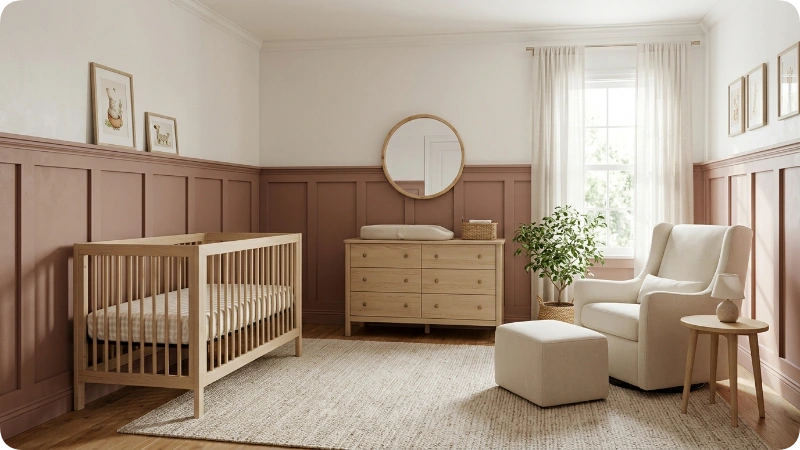
Wall paneling adds texture and architectural character without requiring a busy pattern.
Board-and-batten, picture-frame molding, and simple vertical paneling can all work in a nursery.
Painted in one color, paneling creates subtle shadows and depth.
Soft sage, warm white, muted blush, and pale gray are suitable choices.
How to make it work:
- Choose a paneling style that fits the room’s proportions.
- Keep molding details simple in smaller rooms.
- Paint the wall and trim in the same color for a unified look.
- Plan around outlets, baseboards, and existing fixtures.
- Install securely using methods suitable for the wall construction.
Paneling is a more permanent decorating choice than framed art or decals. It may require additional work to remove or repair.
Best placement: A feature wall away from the crib or across a room where the installation will not create reachable projections.
Design tip: Half-height paneling with a plain painted upper wall can provide texture without making the room feel crowded.
11. Display Meaningful Family Artwork
Not every nursery wall needs a decorative theme.
A few meaningful photographs or custom illustrations can create a personal atmosphere.
Consider framed family photographs, a custom house illustration, or a simple print featuring a meaningful place.
This approach works especially well when the nursery already has patterned wallpaper or colorful furniture.
How to style it:
- Choose a consistent frame color.
- Use a limited number of pieces.
- Keep the arrangement visually balanced.
- Select frames with appropriate secure mounting.
- Place the display away from the crib.
Best placement: Near an adult feeding chair or on a wall visible from the room entrance.
Design tip: Leave space to add new family photographs later rather than filling the entire wall immediately.
12. Add a Large Statement Art Print
One oversized print can be more effective than several small decorations.
Large-scale artwork provides a clear focal point and reduces the need for additional accessories.
Good subjects include abstract shapes, botanical illustrations, landscapes, or gentle animal artwork.
The key is choosing a print that fits the wall.
A narrow wall may suit a vertical illustration, while a wide wall above a dresser can support a horizontal composition.
How to choose the right piece:
- Measure the available wall area.
- Consider the furniture below it.
- Choose colors that connect with the room.
- Avoid overly heavy frames where lighter options are suitable.
- Use appropriate mounting hardware for the wall and artwork weight.
Best placement: A clear wall away from the crib.
Design tip: Artwork usually looks more connected to furniture when it is narrower than the furniture beneath it, rather than extending beyond both sides.
13. Decorate a Nursery Reading Corner Wall
A reading corner can become a useful part of the nursery as your child grows.
Instead of treating the wall as purely decorative, use it to support a comfortable reading area.
A framed illustration, a small collection of book-themed prints, or a painted color block can define the corner.
How to create the look:
- Place a comfortable adult chair where it won’t obstruct movement.
- Add securely mounted artwork above or beside the seating area.
- Position book storage where adults can reach it conveniently.
- Use a suitable lamp with inaccessible cords.
- Keep the area clear of unstable or climbable furniture.
As your child becomes mobile, reassess book storage, furniture anchoring, and reachable objects.
Best placement: A corner away from the crib with enough space for comfortable seating.
Design tip: Use artwork rather than additional shelves if the corner is narrow. This gives the area character without reducing usable space.
14. Use Soft Color Blocking for a Modern Nursery
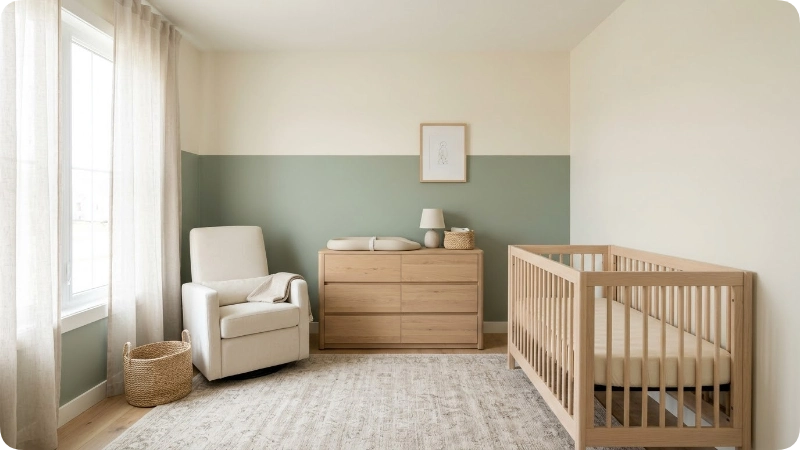
Color blocking uses two or more painted sections to create visual interest.
Unlike a mural, it relies on simple geometric divisions rather than illustrated shapes.
For example, you might paint the lower portion of a wall muted sage and leave the upper portion warm white.
Another option is a vertical color block that visually separates a dresser area from the rest of the room.
How to make it work:
- Choose two compatible colors.
- Decide If a horizontal or vertical division suits the wall.
- Use painter’s tape appropriate for the surface.
- Keep the boundary clean and intentional.
- Repeat the accent color elsewhere in the room.
Best placement: A dresser wall or a section of a shared bedroom.
Design tip: Horizontal color blocking can visually organize a room with several pieces of furniture, while vertical blocks can help define separate activity areas.
15. Create a Subtle Textured Wallpaper Wall
Textured wallpaper adds interest through surface appearance rather than bold color or pattern.
Linen-look, grasscloth-look, and subtle woven-effect wallpapers can make a nursery feel warm and refined.
These finishes work particularly well in minimalist, Scandinavian-inspired, and neutral nurseries.
How to choose it:
- Look for a subtle texture rather than a heavily raised surface.
- Select a washable finish where practical.
- Check installation and cleaning requirements.
- Consider how the wallpaper looks under artificial lighting.
- Avoid products with loose fibers or materials that could become accessible to the child.
Best placement: A feature wall behind an anchored dresser or adult seating area, away from the crib.
Design tip: Textured wallpaper works best when nearby furniture has simple lines. This allows the surface detail to remain visible without competing with ornate pieces.
How to Choose the Best Nursery Wall Decor for Your Space
The right wall decoration depends on more than personal taste. Room size, wall condition, furniture placement, and how long you want the design to last all affect the decision.
| Wall decor option | Visual impact | Commitment | Best use |
| Framed prints | Moderate | Low | Flexible gallery walls |
| Personalized art | Moderate | Low to medium | Individual focal point |
| Painted arch | Strong | Medium | Defining furniture areas |
| Floral wallpaper | Strong | Medium to high | Feature walls |
| Wall decals | Flexible | Low, surface-dependent | Temporary decoration |
| Color blocking | Moderate to strong | Medium | Modern rooms |
| Wall paneling | Strong | High | Architectural texture |
| Large statement print | Strong | Low to medium | Simple focal point |
| Textured wallpaper | Subtle to moderate | Medium to high | Neutral rooms |
These commitment levels are practical design comparisons, not installation or safety ratings. Actual difficulty depends on the materials, wall condition, and mounting method.
For Small Nurseries
Choose one main decorative wall or a single focal point.
A painted arch, large framed print, or restrained gallery wall can add character without making the room feel crowded.
Avoid combining several bold patterns in a limited space unless the colors and scale are carefully balanced.
For Rental Homes
Framed artwork and surface-compatible removable decorations may offer more flexibility than permanent paneling or wallpaper.
Before using adhesives, check your rental agreement and test the product on the actual wall finish.
Removable products can still damage paint, particularly on recently painted or delicate surfaces.
For Nurseries With Existing Furniture
Use the furniture finish to guide your wall decor.
Natural wood furniture pairs well with sage, cream, terracotta, and botanical artwork. White furniture works with a wider range of colors, including lavender, dusty rose, pale blue, and muted green.
You don’t need matching furniture to create a coordinated room.
Where Should You Put Wall Decor in a Baby Girl Nursery?
Placement affects both the appearance and practicality of the room.
A useful approach is to divide the nursery into three areas: sleeping, changing and storage, and adult seating.
Sleeping Area
Keep the crib wall simple.
Avoid hanging framed artwork, mirrors, shelves, garlands, or other decorations above the crib where they could fall or become accessible.
The safest visual approach is often a plain painted wall, with decorative features placed elsewhere in the room.
Changing and Storage Area
A dresser wall can provide a useful location for decorative artwork, provided the furniture is securely anchored and the decorations are mounted safely.
Consider a painted arch, framed botanical prints, or personalized artwork.
Remember that babies can reach and grab nearby objects during diaper changes. Keep decorations and small objects outside their reach, and never leave a baby unattended on an elevated changing surface.
Adult Seating Area
A feeding or reading corner is a good location for softer decorative details.
A framed print, painted color block, or botanical gallery can help define the area without adding floor furniture.
Ensure that nearby lighting, cords, and furnishings remain safe as your child becomes mobile.
How to Make Nursery Wall Decor Look Coordinated
A coordinated nursery doesn’t require matching every decoration.
The easiest method is to establish a small number of visual connections.
Choose a Consistent Color Palette
Select one main wall color and two or three supporting colors.
For example:
Soft Floral
Dusty rose, cream, sage
Woodland
Sage, ivory, natural oak
Modern Neutral
Sand, taupe, warm white
Lavender Garden
Lavender, ivory, soft green
Match the Scale to the Wall
Small prints can look disconnected on a large empty wall. A single large artwork or a grouped gallery may create a more balanced composition.
On a narrow wall, choose a vertical arrangement instead of spreading artwork horizontally.
Leave Some Walls Plain
Every wall doesn’t need decoration.
A floral accent wall can be balanced with simple paint elsewhere. A gallery wall may be enough to give a neutral nursery personality.
Leaving space around decorative features helps each element stand out.
Common Nursery Wall Decorating Mistakes
Even attractive decorations can make a nursery less functional when their placement or scale is poorly considered.
Using too many small decorations: Numerous tiny prints and decals can make a wall feel scattered. Group related artwork or choose one larger focal point.
Choosing decor before arranging furniture: Wall decorations should support the room layout. Arrange essential furniture first, then decide which walls need attention.
Mixing too many patterns: Floral wallpaper, a patterned rug, and several illustrated prints may compete visually. Let one pattern lead.
Ignoring future reach: A decoration that is inaccessible to a newborn may become reachable as the child grows. Plan for changing mobility and climbing abilities.
Relying on unsuitable adhesives: Adhesive hooks and removable strips have product-specific surface and load limitations. Do not assume they can safely support heavy artwork or objects that could fall near a child.
Nursery Wall Decor Safety: What Parents Should Know
Decorative decisions should not create hazards around the baby’s sleep space.
The American Academy of Pediatrics recommends a firm, flat infant sleep surface with a fitted sheet and no loose bedding or soft objects. The Consumer Product Safety Commission provides safety requirements and guidance for nursery products and furniture.
For wall decorations, use these precautions:
- Keep shelves, mirrors, framed artwork, and heavy decorations away from the area above the crib.
- Use suitable anchors and hardware based on the wall material and the item’s weight.
- Keep cords, strings, garlands, and hanging decorations out of children’s reach.
- Anchor furniture that could tip, following the manufacturer’s instructions.
- Inspect wall decals and decorative attachments for peeling or loose components.
- Follow paint and wallpaper installation instructions, including ventilation and curing requirements.
- Be cautious when disturbing old painted surfaces because older homes may contain lead-based paint.
For electrical wall fixtures or work involving existing wiring, use a qualified professional where appropriate.
Before installation, consult current guidance from the AAP and CPSC, along with product-specific instructions and recall information.
Frequently Asked Questions
Can I hang pictures above a baby crib?
Avoid hanging pictures or other objects above the crib where they could fall into the sleep area. Instead, place artwork on a different wall, such as above a securely anchored dresser or near an adult seating area, where it can be mounted safely and kept out of reach.
Are peel-and-stick wall decals safe for nurseries?
Wall decals can be used in suitable locations when installed according to the manufacturer’s instructions. Keep them away from the crib and anywhere a child could peel or reach them. Check regularly for loose edges and remove damaged decals.
What wall decor works best in a small baby girl nursery?
A single large print, a painted arch, or a compact gallery wall can provide a clear focal point without overcrowding the room. Choose artwork that fits the available wall space and keep surrounding surfaces simple.
How can I decorate nursery walls without making permanent changes?
Use framed prints, lightweight decorative pieces mounted appropriately, or removable products compatible with the wall surface. Check rental restrictions and remember that adhesives may still damage some finishes.
Should nursery wall decor match the bedding?
Not necessarily. Wall decor can coordinate with the room’s paint, furniture, and other textiles without matching them exactly. For infant sleep, use a properly fitted crib sheet and keep loose decorative bedding out of the crib.
Conclusion
Baby girl nursery wall decor works best when it adds personality without making the room harder to use.
Floral wallpaper, botanical prints, painted arches, personalized artwork, and gentle murals can all create a beautiful focal point. The right choice depends on your available wall space, existing furniture, budget, and willingness to make permanent changes.
Start by arranging the essential furniture and identifying one wall that can safely hold decorative features. Choose a color palette, add one main element, and leave enough open space for the room to feel balanced.
A nursery doesn’t need decorations on every wall to feel thoughtfully designed.

I am Emma Brooks, a passionate Interior Design Writer and Home Décor Enthusiast at Decoridia. I share well-researched content on home décor, interior design, DIY decorating ideas, furniture selection, color palettes, home organization, and seasonal styling, helping readers create beautiful, functional, and inspiring living spaces for every lifestyle.